Single Particle Sensors
Single Particle Sensors
Single diamond microcrystal sensors are unique due to well-defined crystallographic orientations and provide an appealing alternative to diamond plates for magnetic sensing. Offering a compact and cost-effective solution while demonstrating good sensitivity of ~30 nT/√Hz and a theoretical shot noise limited sensitivity of ~3 nT/√Hz (Sensors 2024), diamond particles with polyhedral shape are used in developments of compact magnetometers (Magnetism 2025).
Single particle sensor products are provided in the Table below.
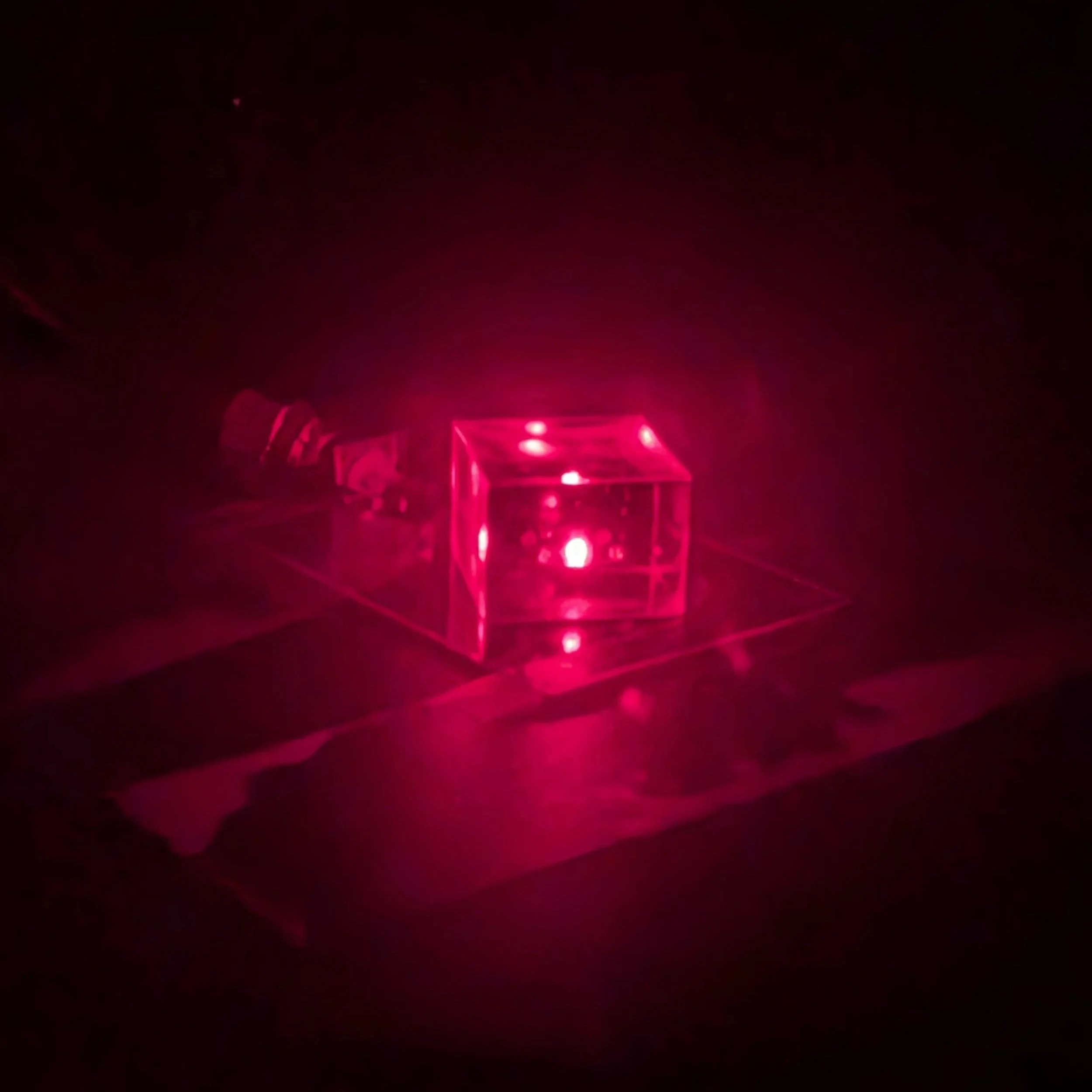
Our NEW product, single diamond particles (~800 um) encapsulated in transparent polymer cuboids, are now available (SKU: ENMDNV800). Each encapsulated particle is accompanied with ODMR characterization. Please contact us if you are interested in specific sizes of the encapsulating polymer matrix. See images below taken with a red longpass filter.

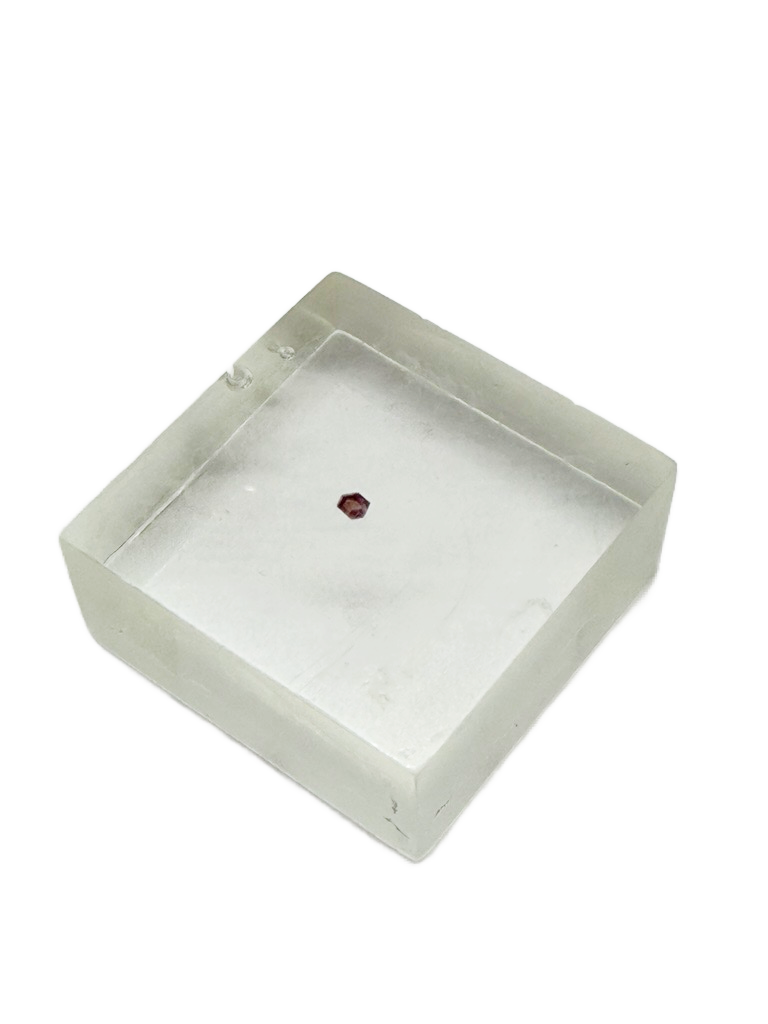
Microdiamond particles with NV centers across three different size ranges which are large enough to be manipulated individually with tweezers are shown in Figure 1. Additional characterization of 800 um particles, including ODMR spectra, T1 relaxation, and Rabi oscillation measurements are shown in Figure 2 and Figure 3.

Figure 1. Microdiamond particles with NV centers across three different size ranges.

Figure 3. (a)Rabi oscillation trace recorded for the a’ line in Figure 2b. A four component exponentially damped cosine fit (red trace) is shown with fitted relaxation components listed. The first two relaxation components dominate the trace. (b) T1 relaxation trace with stretched exponential fit with stretching parameter (ρ = 0.908).

Figure 2. Continuous wave ODMR spectra measured under zero magnetic field conditions (a) and under an applied bias magnetic field (b). In (a), a two-component Lorentzian fit (thin red line) is shown along with microwave power and fit parameters. D is the zero field splitting parameter, E is the strain parameter, and W1 and W2 are the fitted peak widths for each component. In (b), pairs of peaks corresponding to particular NV- orientations are labeled.
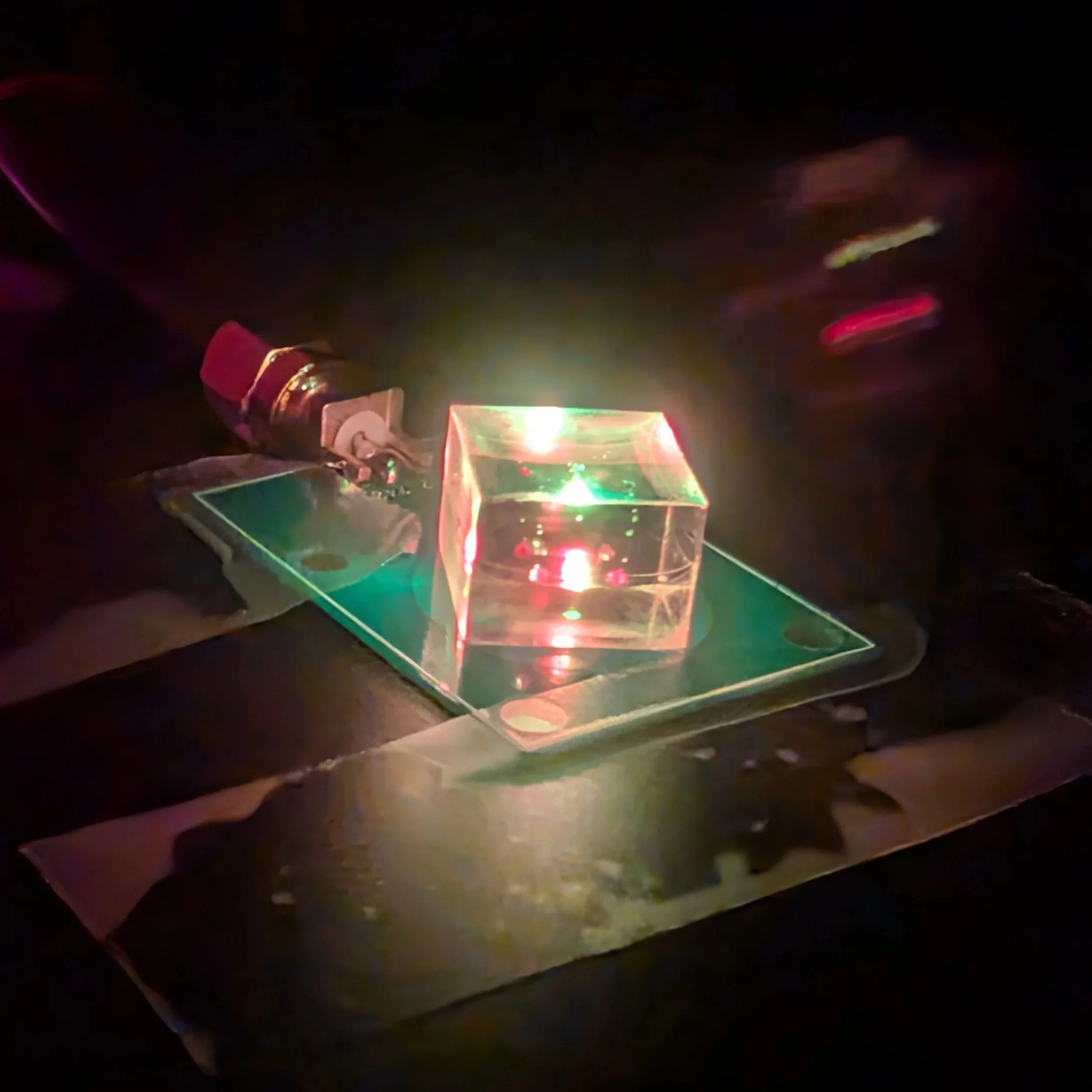
Single diamond particle encapsulated in transparent polymer cuboids (SKU: ENMDNV800) taken with a red longpass filter.